Thursday, November 30, 2006
The Failures of Human Rights Watch
Please read Jonathan Cook's article in Ma'an. Its a scathing critique of Human Rights Watch.
I'd love to hear what you think!
http://www.maannews.net/en/index.php?opr=ShowDetails&ID=17657
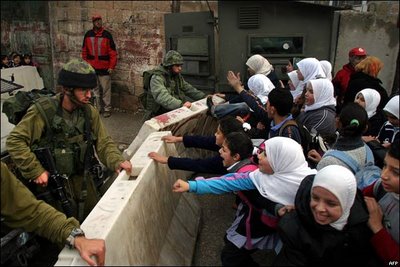
Once again, I think I've posted this picture I took at a flying checkpoint south of Jenin before. Thought it might be appropriate again.
Wednesday, November 29, 2006
Monday, November 13, 2006
Jameela al-Shanti
The Guardian 11/09/06
We overcame our fear
The unarmed women of the Gaza Strip have taken the lead in resisting Israel's latest bloody assault
By Jameela al-Shanti in Beit Hanoun
Yesterday at dawn, the Israeli air force bombed and destroyed my home. I was the target, but instead the attack killed my sister-in-law, Nahla, a widow with eight children in her care. In the same raid Israel's artillery shelled a residential district in the town of Beit Hanoun in the Gaza Strip, leaving19 dead and 40 injured, many killed in their beds. One family, the Athamnas, lost 16 members in the massacre: the oldest who died, Fatima, was 70; the youngest, Dima, was one; seven were children. The death toll in Beit Hanoun has passed 90 in one week.
This is Israel's tenth incursion into Beit Hanoun since it announced its withdrawal from Gaza. It has turned the town into a closed military zone, collectively punishing its 28,000 residents. For days, the town has beenen circled by Israeli tanks and troops and shelled. All water and electricity supplies were cut off and, as the death toll continued to mount, no ambulances were allowed in. Israeli soldiers raided houses, shut up the families and positioned their snipers on roofs, shooting at everything that moved. We still do not know what has become of our sons, husbands and brothers since all males over 15 years old were taken away last Thursday. They were ordered to strip to their underwear, handcuffed and led away.
It is not easy as a mother, sister or wife to watch those you love disappear before your eyes. Perhaps that was what helped me, and 1,500 other women, to overcome our fear and defy the Israeli curfew last Friday - and set about freeing some of our young men who were besieged in a mosque while defending us and our city against the Israeli military machine.
We faced the most powerful army in our region unarmed. The soldiers were loaded up with the latest weaponry, and we had nothing, except each other and our yearning for freedom. As we broke through the first barrier, we grew more confident, more determined to break the suffocating siege. The soldiers of Israel's so-called defence force did not hesitate to open fire on unarmed women. The sight of my close friends Ibtissam Yusuf abu Nada and Rajaa Ouda taking their last breaths, bathed in blood, will live with me for ever.
Later an Israeli plane shelled a bus taking children to a kindergarten. Two children were killed, along with their teacher. In the last week 30 children have died. As I go round the crowded hospital, it is deeply poignant to see the large number of small bodies with their scars and amputated limbs. We clutch our children tightly when we go to sleep, vainly hoping that we canshield them from Israel's tanks and warplanes.
But as though this occupation and collective punishment were not enough, we Palestinians find ourselves the targets of a systematic siege imposed by the so-called free world. We are being starved and suffocated as a punishment for daring to exercise our democratic right to choose who rules and represents us. Nothing undermines the west's claims to defend freedom and democracy more than what is happening in Palestine. Shortly after announcing his project to democratise the Middle East, President Bush did all he could to strangle our nascent democracy, arresting our ministers and MPs. I have yet to hear western condemnation that I, an elected MP, have had my home demolished and relatives killed by Israel's bombs. When the bodies of my friends and colleagues were torn apart there was not one word from those who claim to be defenders of women's rights on Capitol Hill and in 10 Downing Street.
Why should we Palestinians have to accept the theft of our land, the ethnic cleansing of our people, incarcerated in forsaken refugee camps, and the denial of our most basic human rights, without protesting and resisting?
The lesson the world should learn from Beit Hanoun last week is that Palestinians will never relinquish our land, towns and villages. We will not surrender our legitimate rights for a piece of bread or handful of rice. The women of Palestine will resist this monstrous occupation imposed on us at gunpoint, siege and starvation. Our rights and those of future generations are not open for negotiation.
Whoever wants peace in Palestine and the region must direct their words and sanctions to the occupier, not the occupied, the aggressor not the victim.The truth is that the solution lies with Israel, its army and allies -- not with Palestine's women and children.
• Jameela al-Shanti is an elected member of the Palestinian Legislative Council for Hamas. She led a women's protest against the siege of Beit Hanoun last Friday
Friday, November 10, 2006
Money and Leadership...

From CNN: "[They have] one condition, that the siege will not be lifted unless the prime minister is changed," Haniya said, according to Reuters. "When the issue is like this, the siege on one hand, the prime minister on the another ... I prefer the siege be lifted and the suffering ended."
It's amazing to me that the international community is so hypocritical. Let's go over a few facts and figures before I give you a recent article from the Globe and Mail about Avigdor Leiberman, the new Deputy Prime Minister of Israel...
According to a December 2002 report...
- Over 1/3 of total US aid to foreign countries goes to Israel.
- Between 1949 and 2002 US Aid to Israel: $134 Billion
- US Aid PER Israeli: $23,240
- Last year the US financed Israel to the tune of more than $7 Million A DAY.
- Israel ranks SECOND (after the US) in Economic inequality (between rich and poor) and guess who those poor Israelis are... Arab-Israelis and the non-Zionist Ultra Orthodox Jews.
And as for the Palestinians...
- HALF of the Palestinian population live on LESS than $2 a day.
- UN puts the poverty rate of Gazans at 80%.
So what does this have to do with Haniyeh? Why are we hypocrites?
We will have forced a democratically elected leader (in a region we want democracy to flourish in so badly that we started a war) out of office because we have suffocated the life out of the indigenous Palestinian population. At the same time that we starve Palestinian children we finance the construction of the illegal Apartheid Wall, we finance the use of chemical weapons against civilian populations (http://news.independent.co.uk/world/fisk/article1935945.ece) and we keep silent when a racist like Avigdor Lieberman is named Deputy Prime Minister in Israel... But we've been silent in the past over the same things. Menachem Begin, former Israeli Prime Minister once led a Terrorist group that, among other attacks, killed 91 people (British, Arab and Jewish civilians) in July 1946. Begin STEADFASTLY REFUSED TO RECOGNIZE PALESTINE'S RIGHT TO EXIST:We shower Israel with money to buy weapons....
Haniyeh will be forced to step down to save his people...
And Lieberman becomes the new Deputy Prime Minister...
And Begin is given the Nobel Peace Prize...
Thursday, November 09, 2006
Avigdor Lieberman appointed Deputy Prime-Minister
November 7, 2006
Knesset critic urges boycott of Olmert's 'fascist' deputy
Lieberman under fire for plan to expel Israeli Arabs by redrawing the border
By Mark MacKinnon
Jerusalem -- Israel's new Deputy Prime Minister is a dangerous "fascist" who should be boycotted by the international community, a leading Israeli Arab politician said yesterday.
Ahmad Tibi, deputy speaker of Israel's parliament, the Knesset, said that Prime Minister Ehud Olmert's decision last month to invite Avigdor Lieberman into cabinet has given legitimacy to policies that are racist against Arab citizens of the country.
Mr. Lieberman has ignited controversy in recent days by calling for Israel's borders to be redrawn in order to exclude most Arab citizens and make a more homogenously Jewish state. He said Cyprus, which has been divided between Greek and Turkish halves since a war in 1974, was the "best model" for Israel.
"I'm not surprised at all because I know his ideology. But now it's much more dangerous and serious because it's not just the statements of a member of the Knesset, it's the racist statements of the Deputy Prime Minister of the state of Israel," Mr. Tibi said in an interview at his Knesset office.
He compared Mr. Lieberman to other far-right politicians such as Austria's Joerg Haider and France's Jean-Marie Le Pen.
"Practically, he is calling for ethnic cleansing. Using the Cyprus model is outrageous because 160,000 Greek [Cypriots] were deported, by force. But this is the way [Lieberman] sees things."
Over the course of a series of interviews with foreign and domestic media, Mr. Lieberman said that "minorities are the biggest problem in the world" and advocated giving Israel's Arab villages and their citizens to the Palestinian Authority in exchange for Jewish settlements in the West Bank.
Once viewed as a fringe extremist, Mr. Lieberman has seen his popularity rise sharply in recent months. Anti-Arab sentiment in Israel has hardened over the course of the 34-day war this summer against Lebanon's Hezbollah militia, and the ongoing firing of rockets by Palestinian groups based in the Gaza Strip. Recent polls suggest Mr. Lieberman is now the country's second most popular politician, trailing only former prime minister Benjamin Netanyahu, another right-winger.
Mr. Tibi, whose hometown of Taibeh is one of those Mr. Lieberman proposes toexclude from Israel, said the Deputy Prime Minister's popularity reflects growing street-level racism against the Arabs who make up 20 per cent of Israel's population.
A poll taken earlier this year by GeoCartographia, a respected Israeli research group, found that 63 per cent of Israeli Jews saw the country's Arab citizens as a "security and demographic threat to the state," while 40per cent believed that Israeli Arabs should be encouraged to emigrate. The poll was taken in the spring, before the Lebanon war.
"Racism is racism, whether it is in France, Austria or Israel. Lieberman is much more radical than Joerg Haider in Austria. Joerg Haider did not ask to transfer 20 per cent of the Austrian population," Mr. Tibi said. "Lieberman should be isolated and the international community should put pressure ontothe Israeli government to kick him out of the cabinet."
Mr. Lieberman has no love for Mr. Tibi either. Earlier this year, he called for Israeli Arab politicians who had contacts with Hamas, the Islamist group that runs the Palestinian Authority, to be executed. Mr. Tibi, himself a controversial figure who once served as an adviser to Yasser Arafat, flew to Cairo last week to meet with Palestinian foreign minister Mahmoud Zahar, aleading Hamas member. Mr. Tibi has also violated Israeli law by travelling to Lebanon, which is classified as an enemy state.
"World War II ended with the Nuremberg trials," Mr. Lieberman said back inMay. "The heads of the Nazi regime, along with their collaborators, were executed. I hope this will be the fate of the collaborators in this house."
Israeli Arabs aren't the only ones opposed to Mr. Lieberman. His appointment to cabinet was sharply criticized by many on the country's weakened political left, and led to the resignation of cabinet minister Ophir Pines-Paz, a member of the Labour Party, which nonetheless remained in Mr.Olmert's coalition.
Giving Mr. Lieberman the posts of Deputy Prime Minister and Minister for Strategic Affairs was the price Mr. Olmert paid to get Mr. Lieberman and his party, Yisrael Beiteinu ("Our Home is Israel"), to support his coalition government, which was facing the possibility of collapse amidst public dissatisfaction with the conduct and nebulous outcome of the Lebanon war.
While Mr. Olmert was quick to distance himself from Mr. Lieberman's remarks over the weekend, Mr. Tibi said Mr. Olmert should have gone further and dismissed Mr. Lieberman from cabinet.
"You cannot just say that 'I don't agree with these ideas, or these ideas are not representing us.' If you are upgrading him [to Deputy Prime Minister], you are giving him public legitimization, official legitimization and a place from which he can, day by day, express his fascist ideas," Mr.Tibi said.
Mr. Tibi said it was particularly offensive that Mr. Lieberman, who lives in a Jewish settlement in the occupied West Bank and who immigrated to Israel from Moldova in 1978 when he was 21, was claiming the right to take away the citizenship of Arabs who had lived in Israel since its formation.
Wednesday, November 08, 2006
Beit Hanoun

As people slept in their beds in the northern Gaza neighborhood of Beit Hanoun, teenage Israeli soldiers loaded their tanks, turned their turrets towards the center of town and let loose a barrage of shells.
This morning 18 to 20 people, half of whom were children, were blown apart as they slept. Their extended family - mostly women - were also killed and dozens injured.
Now Hamas is claiming that it will resume Suicide Bombings within Israel. All because Israel has decided that the inconvenience of rockets being fired from Gaza into southern Israel merited a response of serial massacres of civilians. Instead of pursuing peace: by dismantling the Apartheid Wall that has ruined thousands of lives in the West Bank and by withdrawing from the Occupied Territories (instead of expanding it's settlements there, murdering Palestinians, and stealing their land) Israel has chosen violence and war. A war it cannot win.
While it saddens me that Hamas [Islamic Jihad has carried out the occasional suicide bombing in Israel during Hamas' official and unofficial cease-fire(s)] has chosen to do this, I doesn't surprise me. Let me review a few of the events that have happened in the past six months that has led to this decision:
- Eight members of a family, three of whom were children, are blown apart by a mortar shell while picnicking on a Gaza beach in June.
- A Family of nine were killed when the Israeli Air Force dropped a 225kg bomb on a residential building at 6 in the morning. July 13th (see Post from this date)
- and today, 20 killed by intentional tank shelling of a residential complex. BBC reports that most were "women and children".
And we are again reminded of the question posed by Dr. Eyad el-Sarraj, the Gazan psychiatrist, outspoken opponent of suicide bombings and winner of the prestigious Martin Ennals Award for Human Rights Defenders: Given the conditions in which the Palestinian people must live the question is not "why are there suicide bombers" but "why is not every Palestinian a suicide bomber"?
From BBC reporter Matthew Price:
A father of one child who was killed told me: "One missile I believe could have been a mistake, but the number of missiles that were fired, I can't believe that was a mistake."
A resident who works in one of Gaza's hospitals says: "I have not seen injuries like this for a long time."
"The shrapnel severed peoples hands and arms and they were left lying on the ground," Dr Ali said.
He had been sleeping in his bedroom when the shells struck the next door building. The windows of his bedroom had been blasted out and there was glass on the ground.
Dr Ali tells the same story as everyone I spoke to, that there had been no anti-Israeli attacks by Palestinian militants from this area, as the Israeli military claims, before the shells struck.
"I am angry. I hate the US, I hate George W Bush, I hate of course Israel. I also hate the Arab states which do nothing to help and the international community," said Raed. But it was not anger in his eyes, it was more like an immense sadness that showed through.
That mood was shared by most of the people we saw, many of them slumped tearfully against walls in the street. Normally when something like this happens members of armed groups turn up and chant slogans with their loudspeakers.
But this time we only saw one militant appear, and he quickly vanished again.
Friday, November 03, 2006
Women and Children

Despite what you see on the news, the situation in Palestine is not just the Israeli Army (with it's Canadian, French, American, British soldiers) against scary, bearded Palestinian Militants. Women and children often are at the receiving end of the former's brutality.
Today after Hamas radio asked for women to demonstrate against the latest Israeli invasion of Gaza, these same women marched towards an-Nasser mosque in Beit Hanoun and acted as a human shield - on their own free will - to help Palestinian "militants" held inside the mosque by the Israeli army. The Israelis, in a fashion that we've seen time and time again, opened fire.

One 40 year old woman is dead - and dozens are injured. BBC has reported that another woman has since also died of her wounds. More than 20 people have been killed in Gaza by the Israeli army in the past three days (including a child) as they relaunch an assault on the strip of land and it's inhabitants - some of the poorest people in the world. Israeli Human Rights Group Bet'selem has reported that 300 Palestinians have been killed in Gaza by the Army since Gilad Shalit (from France) was captured a few months ago.
So keep in mind, as you listen to the Israelis try to spin the story of their soldiers shooting unarmed middle aged women in order to extra-judiciously assassinate men they think might have fired rockets from Gaza into Israel (even though they rarely hit anything) that there is no excuse for this. That Israel is again committing horrible acts of violence. And that it continues to go unaddressed by us in "the West" because he think that we are not involved. We are involved.
***
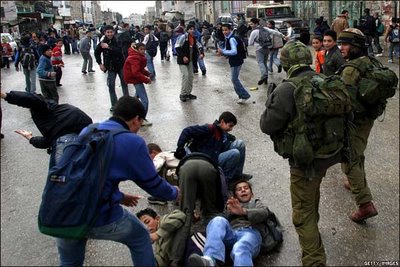
Also remember that violence against the Palestinian people happens VERY DAY and goes unreported here. How about children trying to get to school in Hebron...


The Israelis, needing to protect the Fundamentalist Jewish Settlers in Hebron (see "Hebron" post from July) from the dangerous textbooks of these Palestinian children refuse them access to their school. So they conduct, as an act of defiance, their class in front of the illegal checkpoint.


Later, pubescent boys are beaten and arrested in the streets as they confront the Israeli occupying Army. So threatening those young boys are, with their backpacks and their shifty teenage eyes. Thank god those soldiers have machine guns and bullet proof vests.


If you don't think that Hebron, with it's thousands of soldiers and militant, fundamentalist Jewish Settlers looks bad... check out what they do to Christian Peacemaker Teams and UN International Observers. Or if you want to see some more proof of the difficulties Palestinian children face trying to get to school watch some of the videos provided through the Tel Rumieda Project (an organization dedicated to monitoring Jewish Settlements in Hebron).
http://www.telrumeidaproject.org/video.html

Friday, October 27, 2006
News from Palestine.
Every few day's I'll post a couple of the headlines news stories from the Occupied Territories. Here are today's:
Ma'an is reporting that there is a leaked document from Shin Bet that states that Israel has drawn up an assassination list of Palestinians officials... Including the democratically elected Prime Minister Ismail Haniyeh. The plan would become effective should Palestinian Groups RESUME attacks "in the heart of Israel".
Ma'an is also reporting that Fatah and Hamas are once again close to a "national accord government" and that it will be announced "within days".
Haaretz is reporting that Israeli Defense Minister Amir Peretz (Israel's version of a center-left politician... Hahaha) has no intention of uprooting illegal West Bank Outposts.... we're not even talking about Settlements here... Outposts are the campers and shipping containers housing some of the most radical Settlers.
3 Palestinian men were killed in two separate invasions by the Israeli Army in the northern West Bank. (Haaretz and Ma'an)
Anyway, those are some of today's stories in the Palestinian and Israeli press. You can read them both online: hit the Ma'an News link to the right and this link to Haaretz:
www.haaretz.com
By the way... a great deal of the "comments" in Haaretz's Talkback section are filled with anti-Arab and anti-Palestinian Racism if you ever need to be reminded that those "anti-Semitic Palestinians" are not alone in their bigotry.
Thursday, October 26, 2006
How Embarrassing!
Just to keep you updated: as I said, I'm working full-time at U of T. Office life is a totally different experience from what I've been doing and I'm taking to it shamefully! But I'm also in the process of applying to do PhD's starting in September 2007. I'm just compiling my packages that I'm sending out to my referees for both schools and funding. I'm going to be applying to three schools in the States (two in NY, one in Cambridge Mass.) and to U of T. And I have an appointment on Tuesday to meet a Professor here who could turn out to be my Doctoral advisor - so I'm excited about that!
Other than that I haven't been up to much. Playing Hockey twice a week... Going to Ottawa this weekend for my Mother's 60th birthday celebrations... Wedding planning...
So I'll try and get back into the swing of this and start posting things asap. How about a Slide-Show! That's what I'm going to work on!
Friday, September 29, 2006
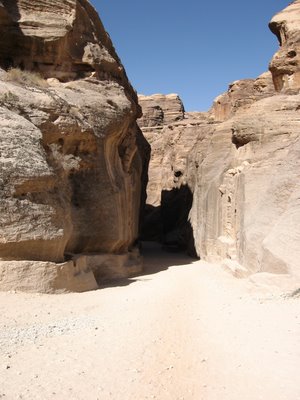
Petra (part 1)

Getting from my hotel in the morning to the bus station where the minibuses head to Wadi Musa was decidedly easier than any of my previous day's travels. In front of the hotel I caught a taxi for the half-hour drive to the bus station in the north end of the city. As often is the case my taxi driver and I had an engaging discussion about the war and what Nasrallah means to the Arab world. His english was exceptional as he described his travels throughout the Arab world and what he thought about each nationality. I learned a lot form him in those fifteen minutes of driving through pre-rush hour Amman traffic. He dropped me next to the proper bus platform and because my ride was metered I felt for the first (and in some ways last) time that I wasn't being ripped off in Jordan.
A group of kuffiyah wearing Arabs sat on a blanket behind the bus - I immediate realized that they were bus drivers and bus-wranglers for lack of a better world when one jumped up and asked me in English where I was going. Standing behind the Wadi Musa bus I answered him by gesturing towards the bus, at which point he showed me to the passenger seat. Excellent! I would get to ride the King's Highway through most of Jordan from the passenger seat of the minibus! My day was starting off right!
When the bus finally filled up one of the men who had been taking his tea on the blanket behind the bus jumped in the drivers seat and we were off.
The signs for Baghdad in the windows of the tour companies surrounding my hotel last night had made me nervous. The first fifteen minutes of the drive to Wadi Musa stirred the same unease in my stomach as we drove through the northern reaches of the city, exiting via an off-ramp marked "az-Zarqa". Just a few weeks ago I had told the man in the Old City of Nablus that I thought the recently killed leader of al-Qaeda in Iraq - Abu Musab al-Zarqawi was "majnoon" - crazy. Now I was driving through the southern reaches of the town that he had come from and that had given him his nom de guerre. I got shivers as I thought of the young Japanese man who lost his life at the hands of Zarqawi two years ago after he had traveled to Baghdad from Amman; probably using one of the tour companies offering those cross-border-and-certain- death journeys that had frightened me so the night before. (See tangent below...). It was the second time that the war in Iraq, raging in the country next door was brought to my mind in the span of 12 hours.
The drive along the King's Highway was pleasant and impressive. It, in a strange way, reminded me of parts of Mexico: desert, mostly flat, and with random restaurant/gas stations that looked straight out of a movie.
The drive took a couple of hours and eventually we began to veer right towards the Jordan that I knew ran beyond the wadis towards our west. Over small hills we drove closer our destination passing through surprisingly vibrant small towns. It was mid-morning when we arrived in Wadi Musa and on our drive into town we passed the hotel where I, with the help of my tour book had decided to stay. Down the hill we continued past dozens of small hotels and restaurants geared towards backpackers. The parking-lot bus station held a few cabs but I decided to walk back up the hill to my hotel. 20 minutes and twenty pounds lighter I arrived at the hotel, drenched in the sweat that poured from my body in the arduous uphill climb that ended up being a lot longer than I had calculated in my mind.
No there were no dorm style rooms (as my book had suggested) but they had a good room and a special rate just for me! Imagine that - two hotels in Jordan offering me a special rate! I braced myself for a heavy quote but it turned out to be not too bad at about 20 Canadian dollars a night. The room itself was exceptional. Large with a King sized bed, the best part was the balcony that looked out over the town in the direction of Petra.
One of the reasons I chose this hotel was for it's pool. I quickly threw on my swim shorts and headed down the hall and around the corner and out into the blaring sun. I slid into the pool and was shocked by what was easily one of the coldest pools I've ever been in. I dunked my head and jumped back out. Shivering I returned quickly to my room to get ready for what would probably be only a half day at Petra.
The front desk got me a cab (fare included in my rate) and I asked to be dropped off in the center of Wadi Musa. I was starving and found the restaurant recommended to me in my tour book (not the best tour book I had decided). The Lentil soup I had was great but my shish kebab was disappointing. I decided that I was ready for the park and jumped in another cab heading for the gate.
At 20 dollars CDN for a two-day student pass into the park, the admission to Petra is a steal. I have read in a number of places that it takes at least two days to experience so I figured I could do it in a day and a half (I'm in good walking shape).

The Siq is the famous two kilometer winding, narrow, water hewn passageway through the rock that leads to Petra but before the entrance to the Siq you need to first walk a kilometer along a more open path that runs parallel to a horse road - where you can hire a horse from the Bedouins to take you to the entrance. In fact, there are a number of transportation options to and within Petra - all offered by the local Bedouins. Horse, horse-drawn buggy, donkey, camel. I didn't ride on any but I do admit, the camel was tempting.
At the entrance of the Siq you get the sense that you're entering some sort of time warp - or that you are going into a hidden world. It was really quite amazing. The Siq itself felt surprisingly long. The ground, often changing from Roman cobble-stones to well swept, hard rock was kept very clean. Along the towering walls, embedded into the stone about hip high were the troughs and ceramic pipes installed by the Nabateans 2000 years ago and carefully maintained and replaced since, that fed the arid Petra with water runoff from the surrounding Wadis. Water, an obvious precious commodity in such a hot and dry place is a hard thing to envision now, in our era of waterbottles (I had two liters in my back pack) . And water in Petra has an interesting history: in the 1960's dozen of tourists were killed in the Siq when a dam broke and the narrow passageway flooded.
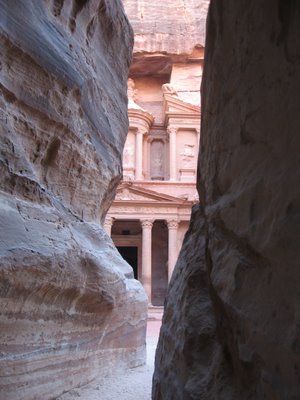
I knew that the Kahzneh lay at the end of the Siq. The Treasury, as it is also known, is the most well preserved of Petra's edifices and as I rounded what I thought was just one more curve in the road, it appeared ahead of me and I stopped dead in my tracks. Rosy pink in the mid-day sun, random tourists gathered at the steps at its base and I stood in awe as its carved pillars and reliefs towered above me. I took a few shots and decided to keep moving. I wandered past ornate entrances to tombs, past the large roman amphitheatre, past ancient buildings that are only now being excavated. The immense size of the complex was almost overwhelming. I peeked into tombs and unknown buildings and chuckled to myself to see that most of these fabulously constructed buildings hold very small, usually single rooms, and are complete empty.
With the red sand of Petra gathering in my shoes, and with Bedouin children, again like their Mexican counterparts trying to eke out a living by selling mass produced trinkets to tourists, I grew tired quickly and decided to return to the Kahzneh where I sat on one of the wooden benches opposite the Treasury and stared at its wonderful artistry and watched the tourists pose at its steps and beside the well placed camels.
At some point I thought I might be able to come back tomorrow and see what I want before moving on that same day to Aqaba and back to Israel. I got up and walked back through the Siq.

***
Pictures:
Friday, September 15, 2006
Any Man's Death Diminishes Me
Here's what I had written into the Petra update...
Nick Berg you will remember was the subject of the first beheading video to be aired by Tawhid wa Jihad (later al-Qaeda in Iraq) - also an alleged victim of Abu Musab's knife. Following al-Zarqawi's death in June, just before I left on my trip, Michael Berg was interviewed on As It Happens, a CBC Radio show in Canada. I was on my way to meet my fiancee at her house outside of Ottawa. The interview brought me to tears as I drove along the highway connecting the city and my suburban destination. He described his feelings of compassion towards the man and the men behind his son's horrific killing, the regret he felt for Zarqawi's death, and how he had come to such forgiveness. I was amazed as the interviewer asked him how he handles the protests that greet his anti-war talks, which have involve pro-Republican, pro-War demonstrators holding up large banners with the image of his son's decapitated head. His response was moving. You can download the audio of that interview (which I might try to transcribe) at http://www.cbc.ca/radioshows/AS_IT_HAPPENS/20060608.shtml
And you can read more about Michael Berg at http://bergforcongress.us/ .
Now back to the Petra Update!
Friday, September 01, 2006
One Night in Amman

Sitting in that bus - now the one heading to Amman - was nearly as nerve wracking as sitting in that other coach heading across the bridge. I wasn't entirely sure that this bus that I was on was the right one. I guess I'm not a fan of buses.
But it was the right one. And while I had held out hope that I could get to Amman in enough time to catch a servees or a mini-bus to Petra that evening, I was quickly convinced that that wouldn't be possible. It took forever to get to Amman. At one point we stopped for no apparent reason. A few people got off and had a smoke... I think the driver's helper got off and picked up his dinner from the BBQ restaurant that we had stopped in front of... I'm not sure what was going on and between my uncertainties and the kid beside me who rarely took his eyes off of me it was altogether another painful experience in what had turned out to be a series of painful experiences.
When we got to what looked like the beginnings of a city I was convinced we were in Amman and while my spirits picked up thinking that I might be able to make it to Petra, the fact that the bus kept on driving through the city for what seemed like an hour, immediately told me that Amman was huge and my ability to get from point A to point B in any semblance of timeliness was extinguished. Yes Amman is huge. With a population of more than a million and a half people, I hadn't been expecting such a city. I live in Toronto here sprawl has given the impression that the city is even bigger than it's nearly 3 million people suggest... but I've been living in rural Palestine for months, where even my trips to the city (Jerusalem) only get me to a place half of Amman's size. Being also fairly familiar with the history of Jordan I had the image in my mind of a much smaller and dispersed place (the territory of Jordan was sparsely populated - and mostly by nomadic bedouins - less than 100 years ago).
So we drove and drove through city - past MacDonalds and Pizza Huts that looked as if they were transplanted physically from suburban North America (again, I hadn't seen a fast food place in months either!) until we eventually came to a large parking lot that was actually the Andali bus station.
I descended from the bus and decided that it being 7pm, I wasn't going to be able to get to Petra that night. I walked across the open space towards a large "hotel" sign, entered on the ground floor and took the elevator up to the 7th floor - the lobby. "For you I'll give you a good price" right "35 Dinars for the night". For such a great deal it sure was a lot for a room. Again I was being ripped off. And again I didn't have the energy to fight it.
The room was nice enough - the air conditioning was especially welcome - and I quickly collapsed on my bed.
An hour or so later, as the sun was beginning to set on Jordan's capital, I left the hotel and walked around. There were a string of book stores off of the square that was the bus station and I went in them looking at the Arabic books. Expensive, I decided not to buy but continued to browse. Cook books, children's stories, books by Edward Said, politics, religion. Many - especially the politics books concerning the Middle East had comically inflammatory (yet in many ways accurate) covers. But then I saw something that I had expected to see, yet had hoped I wouldn't. The cover was a painting of a bearded wizard-like figure with extended hands towards the viewer between which, floated magically, the globe. An innocuous cover in a section with few innocuous covers but immediately I knew what it was. The Arabic title confirmed my disappointment: "Protocols of the Elders of Zion." The book, detailing the "protocols" of a secret Jewish Cabal to a new member describes how this cabal is conspiring to take over the world. Claiming to be an ancient document, The Protocols has been proven to be a hoax and is actually mostly a plagiarized text based on a fictional anti-Napoleon French document from the 19th century. The reality is that The Protocols is erroneously thought to be a real document by some in the Middle East where European anti-semitism has found an audience since the creation of the State of Israel. I knew that you could get the book fairly easily here but still had hoped that it would be harder to find than it turned out to be. In fact, until 2004 you could by a copy of the book online from Wal-Mart throughout North America... and this document gained most notoriety as an anti-Bolshevik text in eastern Europe at the beginning of the 20th century - don't get the impression that this is limited to the Middle East. (For a good set of articles on the current state of anti-semitism check out the October 2004 issue of The New Internationalist magazine at http://www.newint.org/issues/2004/10/01/ )
Leaving the bookstore I continued along my circuitous route around the square. Lined up along most of the four streets were travel agencies. In the windows of the agencies are listed the locations to which they dispatch buses and taxis. You order a taxi ahead of time or take a bus that departs on a preset schedule. I became increasingly uncomfortable in Amman as I passed by each travel agency...
Thursday, August 31, 2006
The Allenby Bridge
Now that I'm half way through it I realize that this is one of the crazier things I've done. I'm sitting in a bus. A large air-conditioned coach... alone. The bus itself is huge with spots for 50 people and it feels so strange to be in it alone. We're idling on the Israeli side of the King Hussein/Allenby Bridge.
I'm on my way to Amman - the capital of the "Hasemite Kingdom of Jordan"- where I will later make my way to Petra. I knew that I wanted to take this border crossing because of the historical importance of the location since before I came to Palestine. I (should have known it would be particularly difficult when I had to get my visa in Canada before I came here - unlike the other two Israel-Jordan border crossings where you can get the Jordanian visa when you show up there. The issue is that the Jordanians don't actually consider it an international border crossing like they do the other two points which cross into Israel and not the Occupied Territories. This made for a difficult experience.
I start my journey after my last Arabic exam. Its just before noon on Monday; first to Ramallah. then to Jericho. Outside of Jericho my servees is stopped at a checkpoint where I nearly die of suffocation in the windowless back seat of the stretch Mercedes. It's nearly 50 degrees outside in one of the hottest towns in the Middle East. All I can think of is Ghassan Kanafani's novella Men in the Sun. "Those poor bastards" I think to myself. Finally at the checkpoint the soldier, my passport in hand, calls out to me: "Mark?" Yes "Where are you going?" Jericho (this is the entrance to Jericho - he must have thought I was in the wrong place) "Are you Jewish?" (He must have thought I was REALLY in the wrong place!).
I make it into Jericho soon thereafter and have a hard time figuring out how to get to the Bridge. One of the (many) flaws in my Arabic is that I can say what I want fairly easily but can't understand the rapid-fire responses that I get. Frustrating. So I take it a Cabbie first tell me that we need to go (back) down the road that I just came from. Im not interested in going back through the checkpoint and ask if there is another way.
He takes me in the opposite direction for 5 minutes when we come to a gated checkpoint. "Ask the soldiers if we can cross" he tell me. I tentatively approach the gate and make my way under the security bar and up to the group of soldiers. The first doesn't speak English and passes my case off to a colleague who does. "Where are you going?" he asks jovially - apparently a random white guy in this place at this time is somehow comical - I can see it I guess. "I'm trying to cross the bridge". He laughs again and says "Ok you can cross".
I jog back to my cabbie and pay him. The soldier wants me to hitch a ride in the back of a tour bus that is going through the checkpoint while I am there. Holding on for dear life, I stood in the back of a an air-conditioned (thank God!) bus filled with Arab-American tourists as it wound its way through dunes and trenches. We approached an intersection and it dawned on me that the only way to really get to the Allenby Bridge is along a settler road - or through the gated checkpoint - the reason that soldier was laughing is that he must have assumed I got lost - or assumed that I had thought that the only way to cross the bridge was going through Jericho. The regular way to cross the bridge, I suddenly understand, is not through Jericho but through the Jerusalem on-ramps to the settler road that bisects the West Bank - the same road my friends and I took to Masada and Ein Gedi a week ago. That's why my cabbie first wanted to take me back in the direction I had come - he wanted to take me back to Jerusalem.
I arrived at the terminal after what was really a ten minute ride. I got off the bus and followed the passengers through two rounds of metal detectors and into a crowded and loud terminal before I'm told by the Israeli at the second security station that I'm in the wrong terminal. It seems I ended up in the Arab terminal when I should have been in the non-Arab (ie. White) building. He politely showed me to a set of double doors where I walked into a large open room. I'm was suddenly alone and I wandered up towards one of the three Passport control booths. The young pretty girl behind the glass (only one of the booths was occupied) pointed me back to another counter at the side of the room where I paid my $40 departure fee. Back at the booth I expected a hassle but didn't even get a question rom her. She looked at my passport, chatted with another young girl colleague who joined her in the booth (apparently someone actually using this terminal draws attention) stamp, stamp, smile, and I was through into a smaller waiting area. There were about a half dozen others waiting on the modular, molded plastic benches. Five minutes later and the passport girl had replaced a colleague at the One-Last-Needless-Documents-Check-Desk. I scanned the room blankly before I asked her: "How do I get to the bridge?"
Surprised by the question she called to one of the staffers who told me that I'd have to wait 10-20 minutes. So I waited, and the others were lead onto a bus - "but not you (me)" - said one of the drivers. After a half hour - some of it slightly panic filled - I was finally told by another teenage girl that I could get on the bus that had just pulled up.
So now I'm on the bus, alone, in the "No-Mans" land between Israel and Jordan.
***
I'm taken across in this giant tour bus, just me and the driver. We chat in Arabic until he starts asking me about something to do with money and a store at which point I tell him I don't understand (I don't) and eventually he desists. I think he was asking me to do something for him and then didn't believe me that I didn't understand him, thinking that I was trying to get out of doing this money-store thing for him. So we continued on in silence. Then he charges me 2 and a 1/2 dinar when we get to the Jordanian side. I know that he's ripping me off (the "2 dinar... no... 2 and a half dinar!" was a dead give away) but I'm so happy to be out of international limbo that I pay up without a much of a complaint.
The bridge itself was a bit of a let-down. Not 30m long it crosses a meek stream-of-a-Jordan River before ending back up in the desert. In the Jordanian terminal both passport officers (not the young pretty girls you find in Israel!) are smoking. I love it - it reminds me of the border between Chile and Argentina, in the middle of the Andes, where the border control guards chain smoke and drop ashes in your passport.
He asks me if I have a visa - I do - and with the help of the tourist police I make my way to a bus that (I hope) is going to Amman.
***
Pictures:
King Hussein and King Abdallah II welcome you to Jordan
The Jordan River from the Allenby Bridge
The Allenby Bridge
Wednesday, August 30, 2006
Khalas!
Anyway, I'm going to put up some of my work (in condensed form) here to elicit some feedback. My goal is to rework parts of it and get it published this fall.
Now I guess I can get back to typing up those blog posts I wrote weeks ago...
Tuesday, August 29, 2006
Why Boycott Israel?

I'll (hopefully!) have my thesis done by tonight and be able to return to posting the last 5 updates from my trip... but for now... something to think about...
Why an Economic Boycott of Israel is Justified
Written by Norman G. Finkelstein
Friday, 07 July 2006
The recent proposal that Norway boycott Israeli goods has provoked passionate debate. In my view, a rational examination of this issue would pose two questions: 1) Do Israeli human rights violations warrant an economic boycott? and 2) Can such a boycott make a meaningful contribution toward ending these violations? I would argue that both these questions should be answered in the affirmative.
Although the subject of many reports by human rights organizations, Israel's real human rights record in the Occupied Palestinian Territory is generally not well known abroad. This is primarily due to the formidable public relations industry of Israel's defenders as well as the effectiveness of their tactics of intimidation, such as labeling critics of Israeli policy anti-Semitic.
Yet, it is an incontestable fact that Israel has committed a broad range of human rights violations, many rising to the level of war crimes and crimes against humanity. These include:
Illegal Killings. Whereas Palestinian suicide attacks targeting Israeli civilians have garnered much media attention, Israel's quantitatively worse record of killing non-combatants is less well known. According to the most recent figures of the Israeli Information Center for Human Rights in the Occupied Territories (B'Tselem), 3,386 Palestinians have been killed since September 2000, of whom 1,008 were identified as combatants, as opposed to 992 Israelis killed, of whom 309 were combatants. This means that three times more Palestinians than Israelis have been killed and up to three times more Palestinian civilians than Israeli civilians. Israel's defenders maintain that there's a difference between targeting civilians and inadvertently killing them. B'Tselem disputes this: "[W]hen so many civilians have been killed and wounded, the lack of intent makes no difference. Israel remains responsible." Furthermore, Amnesty International reports that "many" Palestinians have not been accidentally killed but "deliberately targeted," while the award-winning New York Times journalist Chris Hedges reports that Israeli soldiers "entice children like mice into a trap and murder them for sport."
Torture. "From 1967," Amnesty reports, "the Israeli security services have routinely tortured Palestinian political suspects in the Occupied Territories." B'Tselem found that eighty-five percent of Palestinians interrogated by Israeli security services were subjected to "methods constituting torture," while already a decade ago Human Rights Watch estimated that "the number of Palestinians tortured or severely ill-treated" was "in the tens of thousands - a number that becomes especially significant when it is remembered that the universe of adult and adolescent male Palestinians in the West Bank and Gaza is under three-quarters of one million." In 1987 Israel became "the only country in the world to have effectively legalized torture" (Amnesty). Although the Israeli Supreme Court seemed to ban torture in a 1999 decision, the Public Committee Against Torture in Israel reported in 2003 that Israeli security forces continued to apply torture in a "methodical and routine" fashion. A 2001 B'Tselem study documented that Israeli security forces often applied "severe torture" to "Palestinian minors."
House demolitions. "Israel has implemented a policy of mass demolition of Palestinian houses in the Occupied Territories," B'Tselem reports, and since September 2000 "has destroyed some 4,170 Palestinian homes." Until just recently Israel routinely resorted to house demolitions as a form of collective punishment. According to Middle East Watch, apart from Israel, the only other country in the world that used such a draconian punishment was Iraq under Saddam Hussein. In addition, Israel has demolished thousands of "illegal" homes that Palestinians built because of Israel's refusal to provide building permits. The motive behind destroying these homes, according to Amnesty, has been to maximize the area available for Jewish settlers: "Palestinians are targeted for no other reason than they are Palestinians." Finally, Israel has destroyed hundred of homes on security pretexts, yet a Human Rights Watch report on Gaza found that "the pattern of destruction…strongly suggests that Israeli forces demolished homes wholesale, regardless of whether they posed a specific threat." Amnesty likewise found that "Israel's extensive destruction of homes and properties throughout the West Bank and Gaza…is not justified by military necessity," and that "Some of these acts of destruction amount to grave breaches of the Fourth Geneva Convention and are war crimes."
Apart from the sheer magnitude of its human rights violations, the uniqueness of Israeli policies merits notice. "Israel has created in the Occupied Territories a regime of separation based on discrimination, applying two separate systems of law in the same area and basing the rights of individuals on their nationality," B'Tselem has concluded. "This regime is the only one of its kind in the world, and is reminiscent of distasteful regimes from the past, such as the apartheid regime in South Africa." If singling out South Africa for an international economic boycott was defensible, it would seem equally defensible to single out Israel's occupation, which uniquely resembles the apartheid regime.
Although an economic boycott can be justified on moral grounds, the question remains whether diplomacy might be more effectively employed instead. The documentary record in this regard, however, is not encouraging. The basic terms for resolving the Israel-Palestine conflict are embodied in U.N. resolution 242 and subsequent U.N. resolutions, which call for a full Israeli withdrawal from the West Bank and Gaza and the establishment of a Palestinian state in these areas in exchange for recognition of Israel's right to live in peace and security with its neighbors. Each year the overwhelming majority of member States of the United Nations vote in favor of this two-state settlement, and each year Israel and the United States (and a few South Pacific islands) oppose it. Similarly, in March 2002 all twenty-two member States of the Arab League proposed this two-state settlement as well as "normal relations with Israel." Israel ignored the proposal.
Not only has Israel stubbornly rejected this two-state settlement, but the policies it is currently pursuing will abort any possibility of a viable Palestinian state. While world attention has been riveted by Israel's redeployment from Gaza, Sara Roy of Harvard University observes that the "Gaza Disengagement Plan is, at heart, an instrument for Israel's continued annexation of West Bank land and the physical integration of that land into Israel." In particular Israel has been constructing a wall deep inside the West Bank that will annex the most productive land and water resources as well as East Jerusalem, the center of Palestinian life. It will also effectively sever the West Bank in two. Although Israel initially claimed that it was building the wall to fight terrorism, the consensus among human rights organizations is that it is really a land grab to annex illegal Jewish settlements into Israel. Recently Israel's Justice Minister frankly acknowledged that the wall will serve as "the future border of the state of Israel."
The current policies of the Israeli government will lead either to endless bloodshed or the dismemberment of Palestine. "It remains virtually impossible to conceive of a Palestinian state without its capital in Jerusalem," the respected Crisis Group recently concluded, and accordingly Israeli policies in the West Bank "are at war with any viable two-state solution and will not bolster Israel's security; in fact, they will undermine it, weakening Palestinian pragmatists…and sowing the seeds of growing radicalization."
Recalling the U.N. Charter principle that it is inadmissible to acquire territory by war, the International Court of Justice declared in a landmark 2004 opinion that Israel's settlements in the Occupied Palestinian Territory and the wall being built to annex them to Israel were illegal under international law. It called on Israel to cease construction of the wall, dismantle those parts already completed and compensate Palestinians for damages. Crucially, it also stressed the legal responsibilities of the international community:
all States are under an obligation not to recognize the illegal situation resulting from the construction of the wall in the Occupied Palestinian Territory, including in and around East Jerusalem. They are also under an obligation not to render aid or assistance in maintaining the situation created by such construction. It is also for all States, while respecting the United Nations Charter and international law, to see to it that any impediment, resulting from the construction of the wall, to the exercise by the Palestinian people of its right to self-determination is brought to an end.
A subsequent U.N. General Assembly resolution supporting the World Court opinion passed overwhelmingly. However, the Israeli government ignored the Court's opinion, continuing construction at a rapid pace, while Israel's Supreme Court ruled that the wall was legal.
Due to the obstructionist tactics of the United States, the United Nations has not been able to effectively confront Israel's illegal practices. Indeed, although it is true that the U.N. keeps Israel to a double standard, it's exactly the reverse of the one Israel's defenders allege: Israel is held not to a higher but lower standard than other member States. A study by Marc Weller of Cambridge University comparing Israel and the Occupied Palestinian Territory with comparable situations in Bosnia and Herzegovina, Kosovo, East Timor, occupied Kuwait and Iraq, and Rwanda found that Israel has enjoyed "virtual immunity" from enforcement measures such as an arms embargo and economic sanctions typically adopted by the U.N. against member States condemned for identical violations of international law. Due in part to an aggressive campaign accusing Europe of a "new anti-Semitism," the European Union has also failed in its legal obligation to enforce international law in the Occupied Palestinian Territory. Although the claim of a "new anti-Semitism" has no basis in fact (all the evidence points to a lessening of anti-Semitism in Europe), the EU has reacted by appeasing Israel. It has even suppressed publication of one of its own reports, because the authors -- like the Crisis Group and many others -- concluded that due to Israeli policies the "prospects for a two-state solution with east Jerusalem as the capital of Palestine are receding."
The moral burden to avert the impending catastrophe must now be borne by individual states that are prepared to respect their obligations under international law and by individual men and women of conscience. In a courageous initiative American-based Human Rights Watch recently called on the U.S. government to reduce significantly its financial aid to Israel until Israel terminates its illegal policies in the West Bank. An economic boycott would seem to be an equally judicious undertaking. A nonviolent tactic the purpose of which is to achieve a just and lasting settlement of the Israel-Palestine conflict cannot legitimately be called anti-Semitic. Indeed, the real enemies of Jews are those who cheapen the memory of Jewish suffering by equating principled opposition to Israel's illegal and immoral policies with anti-Semitism.
Norman G. Finkelstein received his doctorate in 1988 from the Department of Politics, Princeton University, for a thesis on the theory of Zionism. He currently teaches political theory at DePaul University in Chicago. He is the author of five books, including Beyond Chutzpah: On the misuse of anti-Semitism and the abuse of history and The Holocaust Industry: Reflections on the exploitation of Jewish suffering.
***
Pictures:
A Palestinian Home in Bethlehem, surrounded by the 10m high wall on 3 sides.
Will Israel read the writing on the Wall?
Friday, August 25, 2006
Yad Vashem

This post was written August 2nd.
Yad Vashem is Israel's Holocaust Museum. It's where, unfortunately, the government brings its foreign dignitaries. Its perched atop Mt Herzl, named for modern Zionism's historical originator. I went there on Sunday. It was impressive and moving. By far one of the most well constructed and presented museums I've ever seen. I can't even fathom the amount of money it took to build it. And as I wandered amongst the teenage soldiers and looked at the moving artifacts of one of the worst moments in human history, I felt overwhelmed. I also felt deeply disturbed by it all. The content was, of course, troubling beyond description - and I felt a similar way in Anne Frank House in Amsterdam a couple of months ago. But also disturbing was the way the Holocaust was historicized into a Zionist narrative.
My friend al-Hawal, who went to Yad Vashem a week before I did explains it very well. I'll let him speak for me...
Thursday, August 24, 2006
One Point on Israeli Spin
The rhetorical use of UN Security Council Resolutions (and them not being carried out) by the Israeli Government is one of the most laughable acts in this war full of tragedies.
I just want to remind everyone that Israel has no interest in fulfilling UN resolutions. Here are a couple of UN Resolutions that Israel has decided to ignore...
111
127
162
171
228
233
234
237
242
248
250
251
252
259
267
271
298
338
339
381
425
446
452
465
468
469
471
476
478
484
508
509
512
513
515
516
517
518
520
521
573
592
605
607
608
611
636
641
672
673
681
694
726
799
904
1073
1322
Let me quote from the infamous Resolution 242 in particular. It calls for the "Withdrawl of Israel armed forces from territories occupied in the recent conflict".
The Dead Sea


We drove back up the road to Ein Gedi, the Resort and Spa "town" on the Dead Sea, just inside Israeli territory. I put "town" in quotation marks because I never actually saw a town. We passed a resort and pulled into a parking lot adjacent to twined, single storey buildings, housing an ice cream and snack stand and public change rooms.
We changed into our swim shorts and headed down the concrete path to the calm waters of the Dead Sea. Having forgotten my flip-flops the soles of my feet burn as I quickly run down the path towards the lowest point on earth and what I hope for my feet's sake is a cool reprieve.
It's not much of a beach. In fact it's more like the shore of a lake somewhere in the Muskokas. No sand to speak of just grass and dirt up to a thin strip of rocks with calm waters lapping gently against their slippery sides. John warns us not to touch our eyes with our hands once they have the salt water on them.
We slide into the water and are quickly thrown up in an awkward motion that propels our torsos to the surface. I squirm around trying to get into a stable position. I'm on my back now and my feet are inches above the surface - I can't put them under the water if I tried. But as I adapt to my new surroundings the blaring sun of the Judean desert is making the sunscreen on my forehead sweat into my eyes. I can't see and it stings! I can't wipe it out of my eyes as I would without a problem if my hands weren't covered in salt water. Ahhh!
Patrick takes a couple of pictures of us floating in the Dead Sea. Every second is agony. Hurry up! say under my breath. He finishes and I quickly return to shore. Between the agonizing rawness of the bottoms of my feet with the corresponding walk of a hobbled man, and the difficulty in actually opening my eyes I am quite the site as I fumble my way to the shower. I'm squinting, walking on the sides of my feet and cursing the Dead Sea.
***
Pictures:
Wadis surrounding the Dead Sea
Playing Catch-Up
I've also received a number of... "is your blog finished"? The answer is no.... I have to (at least) post the number of entries I've already written (mostly by hand). I also want to post a few of my concluding observations about what the trip has meant for me as a human being and I think that may take a little while. So I'll add more to the blog over the next few weeks - some of it things I've done and written over the last two weeks as I've had limited internet access (including a response to a comment by my friend aka. The Mad Rapper about the possibility of a one-state solution). I want to post some of my favourite pictures from my trip that some of you have yet to see. Maybe I can also post some of the writings of my friends whose names I can now use a little more liberally - Adam, Luke and John - or Majnoon, Maloomat and al-Hawal.
Well, to start, you can read everything Luke has written over the past few months on a blog he and a friend of his have recently started to archive his writings....
http://www.luke-in-palestine.blogspot.com/
So I will play catch-up over the next week or so - especially when I actually finish this thesis and send it off. Stay tuned!
Saturday, August 19, 2006
Munther

About a month ago I wrote about going to see an oud concert in Ramallah and following the concert up with eating a pigeon. One of the three Palestinian men who took us four foreigners to the restaurant and treated us to our first pigeon experience was Munther. This is his story, as told through Luke.
"I met Muther Mahmoud Radwan in the PAS Program Office, the same location in which I presently sit. He struck me as incredibly tall and excessively skinny. He had chiseled features and a very striking face. That same face can hardly be found devoid of a broad smile which speaks to his welcoming disposition. After missing a few days of shaving his visage bore a distinct messianic pose, his Christ-like bearing instantly compels. He is 25. He is from a village called Nabi Elias south of Qalqilya, a city of 40,000 people surrounded by the illegal Separation Wall currently being constructed by Israel. He is in his first year of studies at Birzeit University, well behind the majority of his peers in terms of academic development.
When he was not yet sixteen, Munther was kidnapped and jailed by the Israeli army. Munther spent seven years in an Israeli prison.
To learn this fact struck me as very strange. Munther is so happy and jovial I have nicknamed him Abu Sayeed, The Father of Happiness. Everyone on campus is know to him, including students, teachers, and staff. His phone rings constantly. He has friends spread out from the Lebanese border to the Negev. He is well liked. He is extremely popular. He loves, absolutely loves, flirting and teasing local Palestinian ladies.
I heard rumor of a project being developed by Chris and Ron. They are making a movie to be accompanied by still photography, of prison stories from Israeli jails.(www.stricklyimaging.com) Ron's mission, as a Jewish American and product of a strict Zionist upbringing, is to remove the mask that is Israeli moderation as it is reported in our home country. He wants actual stories from actual prisoners on their circumstances, their time, and the lasting physical and psychological effects of Israeli prison. For this project, they need case studies.
I suggested Munther.
Because of his time in prison (which would have otherwise been spent in Secondary School) Munther speaks no English. When I introduced Munther to Ron and Chris it became apparent that translation would be necessary for the venture to go forward. I volunteered what remain today as my completely amateur services. Since I arranged the meeting, they were heartily accepted. I think Ron and Chris both think I speak much better Arabic than I actually do. Nonetheless, the date was set. Thursday afternoon. Munther's small flat here in Birzeit.
We meet Munther in the PAS office and accompany him to his home. Upon arrival we are welcomed by what seems to be the entire neighborhood. Youths and adults arrive from all sides of the street shaking hands and asking questions. "What is going on? Why is there a camera? Who is famous here? Will this be shown in the United States?"
The questions amuse me and Ron and Chris as well when I translate them. Still, they are very serious questions from the gathered crowd. Munther is about the share the darkest part of his life with us and it was assumed this would be big news everywhere, including in America. I explained that Ron hoped that this would be shown at small film festivals in the United States but for another six months or so. They seemed disappointed but there was little else that could be said. We sat on the balcony and drank tea. Chris and Ron arranged their equipment. Munther found a picture of Abu Ammar (Yasser Arafat) and the filmmakers decided to tape it up behind Munther's head. Munther remains a staunch Fateh supported, quick to criticize Hamas if asked.
The interview began.
Munther discussed his early childhood and life in Nabi Elias. He discussed his father's farm and their quiet existence in Palestine. Little by little, he reported, things began to change and life became more difficult. The First Intifada was difficult around Qalqilya as Israeli soldiers brutalized civilian populations. He was very young but remembers his friends and older brothers beaten in the streets and his family threatened. He described the sense of indignity that came with these actions as more and more Palestinian men were subjugated by Israeli soldiers, their livelihood and man hoods taken away piece by piece. The psychological effect of these policies seemed to weigh more heavily than the physical ones. Munther's face was no longer supporting a wide smile.
He described his teenage years and his political activism. Fateh was and is very popular in his village and around Qalqilya. He became a new recruit, a teen aged soldier running missions against Israeli soldiers on behalf of politicians who were seldom in danger. "Old men make war for young men to die in," I told him. "Suh" he said. "That's right."
He went on to tell of his subsequent capture and arrest by Israeli soldiers just prior to the breakout of the Second Intifada. He was a known fighter and they were trying to improve their military odds when tensions in the West Bank began to increase. He attempted to flee arrest and was shot in the leg. He was then drug to a local detention center were he was left, by himself, wounded and bleeding, for 22 hours. He was 16 years old.
From there he was taken to a hospital for treatment. He was bound for all medical procedures. He was removed back to a holding cell. For nine days he awaited some manor of trial or charge. For nine days none came.
During these nine days, Munther was denied food and water. He was made to urinate and defecate where he sat in a 1 by 1 and a half meter room, or alternatively, in an office for questioning. These sessions of questioning ring like all the most gruesome Hollywood movies you each may have seen.
His legs were bound to a chair. He arms were bound behind him. He was beaten with truncheons by two guards in his head, chest, neck, and back. He was beaten until he passed out from pain. He was revived and beaten some more. These sessions lasted two to three hours and occurred every day for the first several days of his imprisonment. He still bears the scars of these beatings today.
He was officially charged and placed in general detention. He served time with some of the most hardened resistance fighters in all of Palestine. He began his sentence when only 16. He watched the Israeli soldiers carefully, he listened to them. He speaks perfect Hebrew today as a result. Following a year or two, two of his brothers were also imprisoned. He confessed to me that the best times of his life in jail were being with his brothers and the other friends he made while in jail. His smile returns slightly when he says this to me.
Once, he became angry with an Israeli soldier. At this time, he was sharing a cell with 12 to 15 other prisoners. His anger boiled over at the constant abuse and harassment at the hands of the Israeli soldiers. He hurled a metal cup at an Israeli guard and hit him in the head with it. He was beaten severely as a result.
For the next two years, as punishment for his resistance to the inhumane treatment of the Israelis, he served his time in a one meter by one and a half meter room. He ate, slept, defecated, and urinated in the same room. He was not allowed to bathe for months at a time. He was beaten weekly. None of these beatings were accompanied by questioning. The beatings endured for the sake of punishment only.
We asked him about the current political situation. He responded with passion:
"What are we supposed to do? You are from America, if America was occupied and invaded, wouldn't you defend yourselves? Defend your homes? We are only protecting our friends and families. Our homes and businesses. We are defending ourselves against aggression. How does this make us terrorists? What should we do instead, welcome the settlers who take our land? I don't know of any people who would do that. This is where we are today."
Munther also spoke on his time today in the university:
"I know everyday that I am behind my peers. I am behind my classmates. I go to lectures and I see they all understand without study. I study for an hour, two hours and I still don't understand. The years I had when I was young are gone and I will never catch up. I am lost in that world, I am different. I know these things everyday."
Munther fought. He resisted. He defended his home and his family.
The Occupation is illegal. Settlements are illegal. Israeli targeting and killing of innocent civilians is illegal."
***
Picture
Munther at home - Photo by Chris Strickland